One source of truth
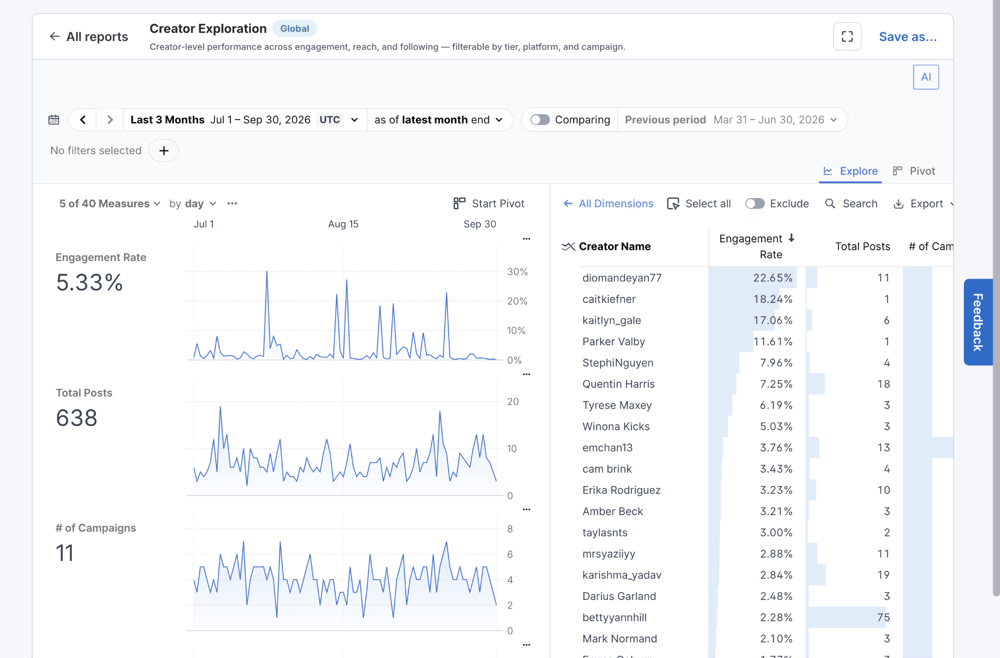
Data standardization and a single view of creator program performance replaces conflicting reports from different teams, so leaders can focus on what matters most.
Forrester Total Economic Impact™ study | October 2026
Forrester Consulting modeled the three-year impact of CreatorIQ for a composite $10 billion enterprise, uncovering $5.3 million in net present value and more than 80% less time spent on creator discovery and reporting.
Three-year, risk-adjusted results for a composite organization. Source: The Total Economic Impact™ of CreatorIQ, a commissioned study conducted by Forrester Consulting on behalf of CreatorIQ, October 2026.
“We moved from a system where performance was being tracked very haphazardly (if at all) to one that is outcome- and data-oriented, which is where the best brands in the world are.”
“[CreatorIQ] is a scalable solution that … enables our partners, creator agencies, and internal brand team to manage the end-to-end flow, from creator identification to validation of content.”
“We saw a dramatic improvement from 2024 to today. We were lagging behind, and today we are top tier in our category. We’re in a better place.”
The full study gives you the financial model, not just the headline numbers. Read every assumption, source, and risk adjustment, so you can rebuild the case with your own data and learn from the success stories of real CreatorIQ customers. Inside, you’ll find:
This study is built for anyone who has to defend, fund, buy into, or scale a creator marketing program:
The value, quantified
In Forrester’s model, a composite $10 billion enterprise earns $6.8 million in benefits against $1.4 million in costs over three years. Financial amounts are three-year, risk-adjusted present values; operational metrics describe the modeled composite organization.
The business case
Creator marketing is taking a bigger slice of the marketing mix, and leaders want proof that goes beyond vanity metrics. CreatorIQ’s State of Creator Marketing 2026–2027 found average annual creator marketing investment reached $4.8 million, up 33% year over year.
The six decision makers Forrester interviewed know the feeling. Before CreatorIQ, their teams faced four common problems:
Interviewees said saving time wasn’t their main reason for investing. They wanted to level up. The goal was to scale their programs, build strategy, and earn credibility through better data.
“The conversation was more about ‘We want to show the execs how things are working across the company, instead of one team providing data that’s completely different from another team. This can help us show how creator marketing is working, instead of getting 25 reports from 25 teams that don’t add up to total performance.’ That was an easy sell to execs.”
Beyond the model
In addition to the quantified benefits Forrester calculated, interviewees spoke about four unquantified benefits they also received from investing in CreatorIQ:
Data standardization and a single view of creator program performance replaces conflicting reports from different teams, so leaders can focus on what matters most.
CreatorIQ helps teams spot which creators perform best in which campaigns, so they can bring the standouts back. Repeat partnerships build familiarity and engagement.
Visibility across the enterprise supports consistent practices, on-brand briefs, and a closer look at creators with controversy or regulatory risk in their history.
Comparable performance data helps creator teams argue for funding, benchmark creator CPM against other marketing, and negotiate rates with confidence.
“CreatorIQ was fundamental to raising our game on creator marketing. We can now make apples-to-apples comparisons and ensure brand safety.”
FAQs
Explore the study’s findings, assumptions, and what they could mean for your creator marketing program.
The composite organization achieved a 373% ROI and $5.3 million in net present value over three years. The risk-adjusted analysis models $6.8 million in benefits compared with $1.4 million in costs on a present-value basis. Forrester based the composite organization and financial model on interviews with six decision-makers experienced with CreatorIQ. Actual results will vary based on each organization’s costs, operational environment, and creator marketing program.
Interviewees’ organizations struggled to consistently measure creator performance, independently verify data, and efficiently consolidate information from disparate sources. Creator discovery relied on scanning personal social feeds, using separate platforms, soliciting agency recommendations, and manipulating spreadsheets. Post-campaign reporting required extensive manual data aggregation, and some teams only updated overall performance data monthly. Without clear and trusted metrics, creator marketing teams also struggled to develop data-driven strategies and substantiate program performance to organizational leaders.
Interviewees experienced more efficient operations, while the composite analysis models increased reach, improved click-through performance, and reallocated agency spending. The composite organization reduces creator discovery time from 5 hours to 1 hour and post-campaign reporting time from 20 hours to 2 hours. The analysis models 84% growth in creator-driven impressions and 72% more clicks over three years, contributing $1.2 million and $1.3 million in respective risk-adjusted, present-value profit benefits. It also models $3.8 million in marketer time savings and $497,000 in agency tool costs reallocated to other services.
According to interviewed customers, CreatorIQ centralized the data and workflows used to discover, manage, govern, and measure creators and creator marketing programs. Interviewees used centralized creator data, keywords, engagement rates, sample content, lookalike functionality, and performance metrics to inform creator selection and campaign decisions. The platform supported standardized reporting across internal teams, agencies, and external partners while integrating with other enterprise data and analytics systems. Interviewees also associated greater data visibility with stronger governance, brand consistency, brand safety, and internal advocacy for creator marketing programs.
The three-year, risk-adjusted present value for required costs was $1.2 million for licensing and $268,000 for implementation and management. Interviewees completed implementation in one to two months, and the composite model assumes a two-month implementation period. To support its 75-seat deployment, the composite organization assigns one FTE during implementation and allocates one-half of one FTE to ongoing management. The model includes 2 hours of initial training per user and an additional hour annually.
In Forrester’s model, CreatorIQ cuts creator discovery from five hours to one hour per creator (80% less time) and post-campaign reporting from 20 hours to two hours per campaign (90% less). Over three years, that saves the composite organization 222,460 hours. Interviewees credited having each creator’s data in one place and pulling reports from a single platform instead of merging spreadsheets.
Forrester modeled 84% growth in creator-driven impressions and 72% more clicks over three years for the composite organization, worth $1.2 million and $1.3 million in risk-adjusted profit (present value). The growth comes from a bigger program, with creator partnerships rising from 1,650 to 4,800, and a 5% lift in click-through rate as performance data guides creator selection.
In the study, the composite organization stopped paying five agencies about $50,000 each per year for proprietary tracking platforms. That freed up $600,000 over three years ($497,000 in risk-adjusted present value). Interviewees expect to keep working with agencies, so the money shifts from technology to strategic and operational services, and the organization keeps ownership of its creator data.
For a 75-seat deployment, Forrester modeled for the composite organization total costs of $1.4 million in present value over three years: $1.2 million for licensing (including API access, competitor benchmarking dashboards, and affiliate functionality) and $268,000 for implementation and management labor. Costs vary with seats and add-ons, so contact CreatorIQ for pricing.
Yes. Interviewees ranged from a six-seat travel program to a 500-seat food and beverage deployment, at companies with $5–105 billion in annual revenue. The largest customer said the platform performed reliably with hundreds of people using it at the same time.
Not necessarily. Forrester makes no assumptions about the ROI other organizations will see and advises readers to plug their own estimates into the study’s framework. Your results will depend on your program’s size and growth pace, how many tracking platforms you use today, which tasks you outsource to agencies, your baseline click-through and conversion rates, your average order value, and how many users and agencies need platform access.
Get the full study
Dig into the complete financial model, assumptions, and customer insights behind the 373% ROI.
By submitting this information, you agree to our Privacy Policy and Terms of Service.
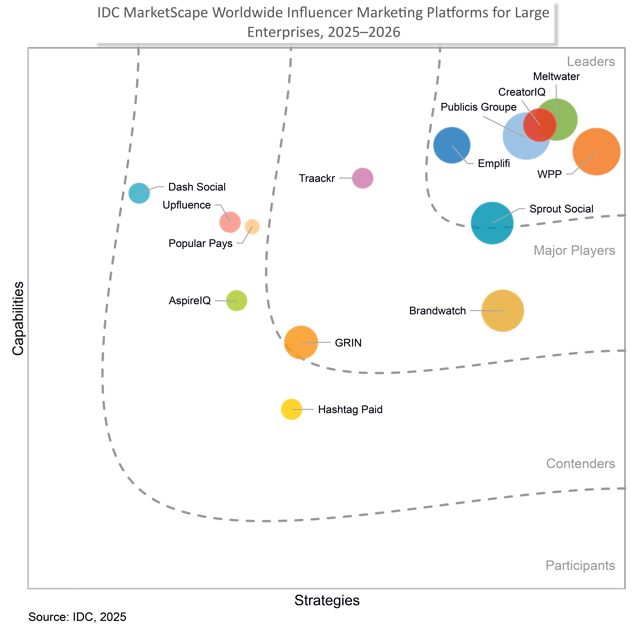
Analyst report CreatorIQ named a Leader in IDC MarketScape An independent assessment of platforms built for large enterprises.
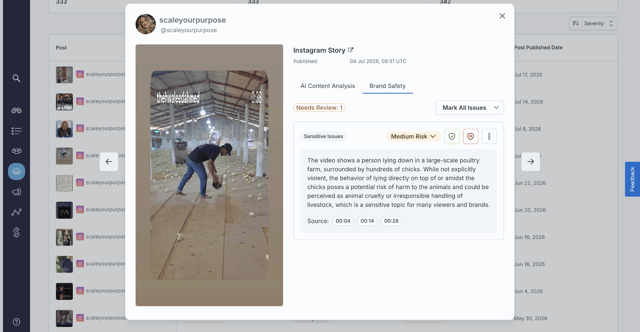
Brand safety SafeIQ brand safety How enterprise teams apply their brand standard across creator programs. 
Find out how CreatorIQ helped enterprise teams discover, protect, measure, and scale creator marketing.
The Total Economic Impact™ of CreatorIQ, a commissioned study conducted by Forrester Consulting on behalf of CreatorIQ, October 2026. Results are three-year, risk-adjusted present values for a composite organization based on six interviewed customers. Forrester makes no assumptions as to the potential ROI that other organizations will receive. Forrester does not endorse CreatorIQ or its offerings.