


State of Creator Marketing 2026-2027
Key findings from CreatorIQ’s seventh annual global influencer marketing survey, and what to expect in 2027 and beyond
 CreatorIQ Research
Introduction
Creator marketing has evolved. Now, its infrastructure needs to keep pace
Here’s how it used to work: you liked something, you told someone, they bought it, they told someone else. Social media platforms detonated this linear network of influence, replacing it with an always-on, algorithm-fueled system capable of turning a single recommendation into purchasing decisions at massive scale.
What began as a new way to reach consumers now fuels content, paid media, commerce, brand strategy, and more. AI advances heightened this transformation, resulting in a complex operating environment with more stakeholders, more content and data to manage, and more systems to connect.
Last year, CreatorIQ declared the Era of Efficacy: creator marketing had proved its value and agility, and organizations were investing accordingly. After efficacy comes a new question: what happens when creator marketing works, and at scale?
It’s no surprise that the No. 1 roadblock for brands has shifted from measurement to integrating creator marketing data and workflows across marketing systems. That shift points to an emerging infrastructure gap: creator marketing has expanded faster than the systems and processes built to support it. Scale is important, but the next advantage is effectively coordinating it. Leading organizations will be those that connect people, processes, data, technology, and AI, while preserving the human connection at the heart of creator marketing.
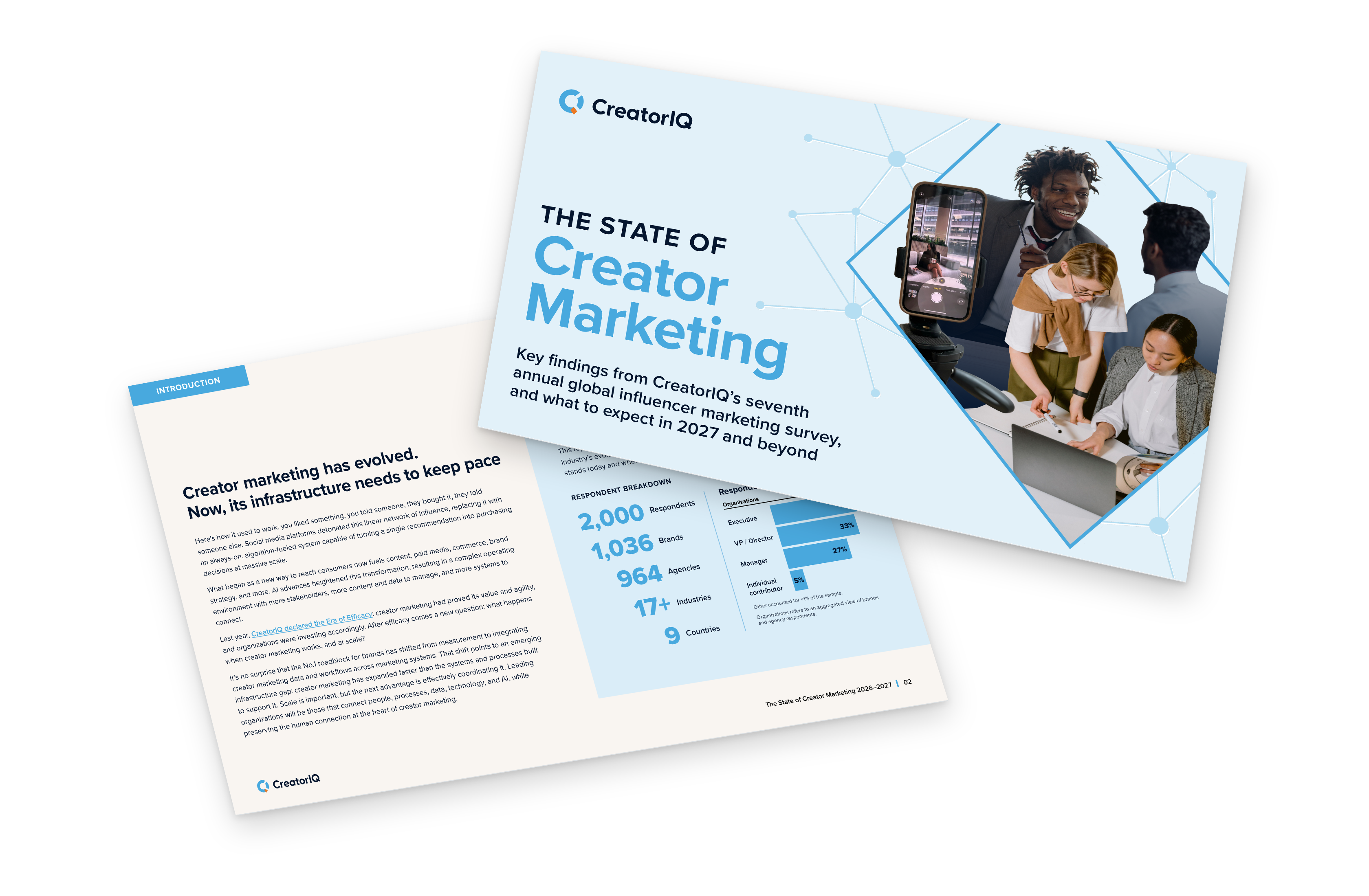
CreatorIQ partnered with Sapio Research to survey 2,000 brands and agencies on how the marketing landscape has transformed over the past year. This report puts those findings in the context of seven years of research into the industry’s evolution. Together, the data offers a view of where creator marketing stands today and where it’s headed next.
Respondent Breakdown
Organizations*
Other accounted for <1% of the sample. *Organizations refers to an aggregated view of brands and agency respondents.
ROI & Investment
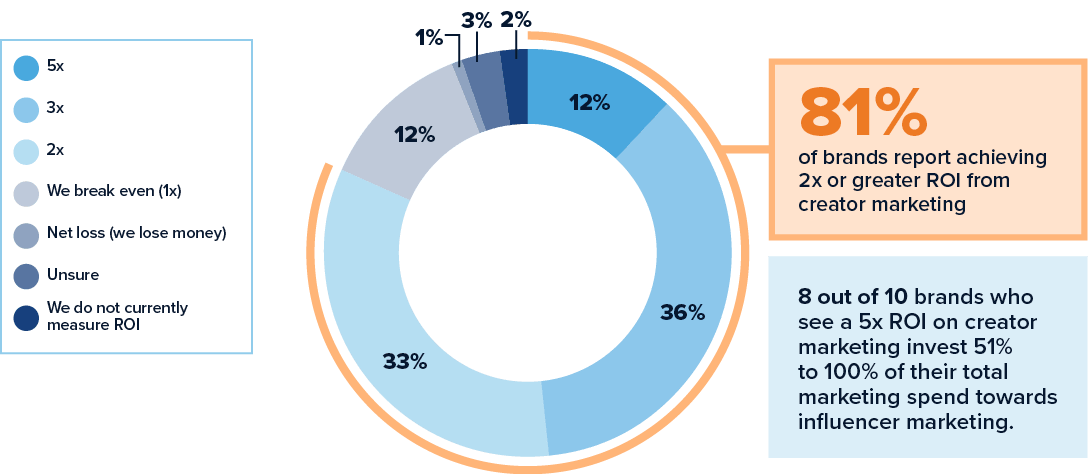
Nearly half of brands now report 3x or greater ROI from creator marketing
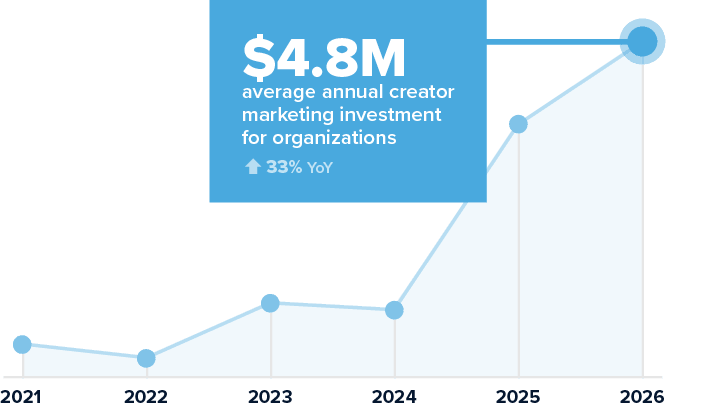
Creator marketing is delivering stronger returns and continues to attract more investment. The average annual creator marketing investment for organizations reached $4.8M, up 33% YoY, while enterprise investment climbed to $8.8M, nearly $2M more than last year.
Average Annual Creator Marketing Investment
$8.8M
average annual creator marketing investment for enterprises
Nearly $2M more than last year
The increase is more measured than last year’s historic surge, but the trajectory is clear: organizations are putting more money behind creators because that investment is delivering. Growing investment increases the expectations, scale, and complexity around content creation, putting new demands on marketing infrastructure.
Now, 48% of brands report earning 3x or greater ROI from creator marketing, up from 37% last year. The share who report 5x ROI has doubled, while brands breaking even or reporting a net loss fell from 21% to just 13%.
66%
of organizations report YoY investment has increased
73%
of agencies say ROI for clients’ creator marketing programs increased YoY
ROI for brands
What is the return-on-investment (ROI) of your creator marketing program?
The success of creator marketing expanded its remit. Agencies are seeing that evolution firsthand. Nearly every agency surveyed says clients expect more from their creator marketing services than they did a year ago. Those expectations span marketing functions: faster content production, greater paid and cross-channel integration, more effective use of AI, deeper governance, stronger business impact, and commerce. Creator marketing now has a mandate to deliver more, for more parts of the business.
How client expectations have changed YoY
Agencies
- Faster campaign turnaround and increased content production 42%
- Greater integration with paid media and cross-channel marketing 40%
- More effective use of AI in creator marketing 36%
- Deeper creator vetting, brand safety, and governance 35%
- More focus on measurable business impact and ROI 34%
- Stronger focus on commerce or affiliate 33%
- More complete measurement and attribution 28%
- No major changes 1%
Last year
Strategic guidance on AI, automation, or new platforms was the No. 1 thing clients expected more of from agencies.
This year
Faster content production and paid media/cross-channel integration have risen to the top.
Organizational Structure & Content Reuse
Creator content has expanded beyond a single function
Creator content is repurposed in at least nine areas, with 56% of brands repurposing it beyond social media.
Throughout the year, CreatorIQ asked marketers whether they repurposed creator content. The percentage who did kept rising. This year, 99% of brands reported doing so, rendering a new question more useful: where does creator content live?
Nearly everywhere. More than half of brands say the primary destination is outside of social. Paid social and digital advertising still tops the list for where brands repurpose creator content at 26%. Another 17% repurpose creator content on brand-owned social channels, followed by websites at 13%. Creator is also moving well beyond consumer-facing channels: 11% of brands say internal or executive presentations are its primary destination, ahead of blogs, emails, events, TV, and print.
Creator content is no longer isolated to a single function or destination, a sign of its growing importance. It’s too useful to be managed as a standalone discipline, so marketers need to rethink how they coordinate it cross-functionally, while maintaining clear usage rights and creator permissions.
Where Brands Repurpose Creator Content
Brands
- Paid social or digital advertising 26%
- Organic social (brand-owned channels) 17%
- Website 13%
- Internal or executive presentations 11%
- Blog or editorial 8%
- Email campaigns 7%
- Events 7%
- TV or OTT 6%
- Print 4%
- I / we don’t repurpose creator content 1%
Brand marketing leads creator marketing ownership, but no team dominates
Creator marketing’s footprint is expanding internally. An average of 36 people now contribute to creator marketing for brands, while 41, on average, touch creator marketing at agencies. 61% of brands say the number of people contributing increased YoY, including 24% who report a significant increase.
More people doesn’t necessarily mean bigger creator marketing teams. Brand marketing is the most commonly cited home of creator marketing execution at 20% of brands, followed by social media (16%) and paid media, performance, or revenue marketing (15%). Dedicated creator marketing teams rank fourth for primary ownership at just 13% of brands.
63%
of organizations increased the number of people who touch creator marketing YoY
Ownership of Creator Marketing Function
Which team has primary ownership of executing creator marketing programs at your organization?
Brands
- Brand marketing team 20%
- Social media team 16%
- Paid media, performance, or revenue marketing team 15%
- Dedicated creator marketing / influencer team 13%
- Shared ownership across multiple teams 11%
- Communications & PR 9%
- Agency partner 8%
- Talent & partnerships 7%
Paid Media
Creator marketing is relying less on paid media for funding, even as the two become more intertwined
Last year, CreatorIQ found that roughly two-thirds of brands increasing creator marketing investment were reallocating dollars from digital or paid advertising. This year, 52% of brands with growing creator budgets say that they sourced their increase from paid media or advertising.
Creator marketing is acquiring less of its investment from paid, even as 92% of paid media professionals use creator content in paid creative, with creator content accounting for nearly half of their creative supply. In other words, creator marketing is becoming less financially dependent on paid media, while becoming more operationally intertwined.
The share of increased investment from paid media fell by 12 points YoY, while increases sourced from net-new budgets rose from 33% to 38%. Creator marketing is earning incremental investment of its own. That’s partially because the lines between creator content and paid are blurring.
For half of marketers, influencer marketing budget increases came out of paid or digital advertising budgets
Where did the increase in influencer marketing budget predominantly come from?
Brands
- Paid media / advertising 52%
- Owned social media 45%
- AI-related efficiencies 41%
- Net new budget (i.e. budget was not intended for any other marketing use) 38%
- Print or broadcast advertising 32%
- Events 32%
- Agency spending 31%
- Changes in software stack 28%
- Other marketing channels 25%
- Other <1%
- Unsure <1%
*Asked to those who had an increase in influencer marketing budget. Base: 682.
Last year
64%
of brands reallocated funds from digital or paid advertising
Last year
56%
of brands reallocated funds from owned social media
Last year
48%
of brands reallocated funds from AI cost-cutting measures
Last year
33%
of brands increased investment with net new budget
92%
of paid media leaders and marketing executives use creator content in paid media
For marketers at agencies, on average 54% of their clients’ digital ads incorporate creator content.
“The strongest creator programs today are not just driving engagement, they're helping solve a broader content supply challenge for marketers. Brands are increasingly integrating creator content into their marketing systems from the start, using it to power paid campaigns, social engagement and cross-channel customer experiences. Just as importantly, leading organizations are moving toward a unified view of paid, owned, earned and creator content so they can better understand performance, allocate investments more effectively and maximize the impact of every marketing dollar.”
The Infrastructure Gap
The Infrastructure Gap
Last year, the biggest roadblock for brands executing their creator marketing program was measurement (26%), unseating limited budgets and staff as longstanding top barriers to program success.
A year later, the constraints have changed again. Integrating creator marketing data and workflows across marketing systems is now the No. 1 roadblock for brands, cited by 27%, followed closely by coordinating creator marketing across teams and functions at 26%. Measurement remains a top challenge at 26%, unchanged YoY, as integration and coordination issues rise around it.
Creator marketing has spent years overcoming the barriers that come with an emerging discipline: securing investment, demonstrating performance, and establishing its place in the marketing mix. Those challenges haven’t disappeared. But as creator marketing becomes more interconnected with the rest of the business, the problems rising to the top are increasingly operational.
Creator marketing’s expansion is a sign of a flourishing industry, but it has also created new dependencies. Content has to move between creator and paid teams. Data has to connect across platforms and reporting systems. Programs involve dozens of stakeholders, each with different roles in bringing creator content to life. And marketers measure the outcomes of creator content differently across business units. The industry has scaled faster than the infrastructure needed to support it, creating the infrastructure gap.
Top roadblocks for brands
Over the past year, what roadblocks have you most often faced in executing your influencer marketing strategy?
Brands
- Difficulty integrating creator marketing data and workflows across marketing systems 27%
- Difficulty coordinating creator marketing across teams and functions 26%
- Difficulty measuring influencer performance 26%
- Navigating the impact of AI on creator marketing 25%
For years resourcing was the No. 1 roadblock to program success. Now, inadequate budget and staff are at the bottom of the list, each cited by 18% of brands.
“Creator marketing is growing faster than many brands can adapt. As the opportunity grows, brands spread new capabilities across multiple teams without designing how they will collaborate. Too many organize the work around where people sit rather than how the business makes money.
Shared infrastructure creates a single view of every creator, investment, and result. It gives brands the information to coordinate spending, measure the full business impact and decide what to scale. But someone senior must still set the objective and own the outcome. That combination turns fragmented activity into a serious business capability.”
Measurement & Confidence
Confidence in measurement is high, consensus on the best approach is low
Measurement was creator marketing’s top roadblock just one year ago. Today, 77% of brands say they are confident in their ability to measure creator marketing’s business impact.
That confidence has not produced a consensus on the best approach to demonstrating business impact, and it shouldn’t. The best way to measure creator marketing success depends on the goals at a campaign, program, and business level.
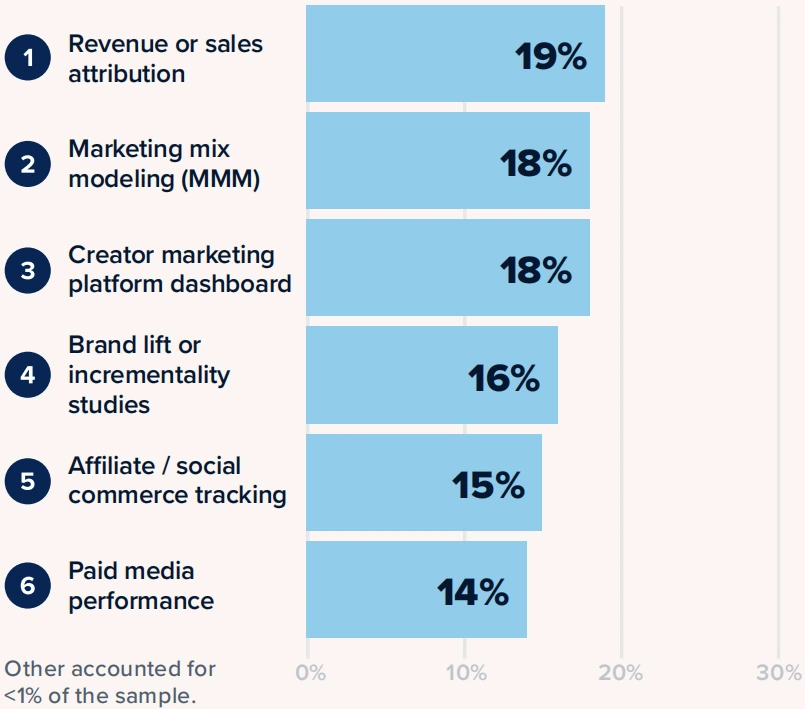
Asked which approach is most effective, brands are almost evenly divided. Revenue or sales attribution leads at just 19%, followed by marketing mix modeling and creator marketing platform dashboards at 18% each. Brand lift or incrementality studies (16%), affiliate or social commerce tracking (15%), and paid media performance (14%) follow closely behind.
The narrow spread is revealing: no measurement methodology is considered most effective by even one in five brands.
That makes sense for a channel whose impact now spans the marketing mix. Revenue attribution and commerce tracking can connect creator activity to sales, while brand lift and incrementality studies capture relevance that attribution alone cannot. Paid media introduces its own performance signals, while marketing mix modeling attempts to understand creator alongside the broader marketing portfolio.
Each of these approaches can provide a clear view of one part of creator marketing’s impact, hence high confidence levels. The challenge is seeing the whole, especially across different metrics, dashboards, and systems.
77%
of brands are confident in their ability to measure creator marketing’s business impact
Most Effective Methods for Demonstrating Business Impact
Which is most effective for demonstrating the business impact of creator marketing?
Most effective methods for demonstrating business impact
Which is most effective for demonstrating the business impact of creator marketing?
Brands
Most effective methods for demonstrating business impact
Which is most effective for demonstrating the business impact of creator marketing?
Agencies
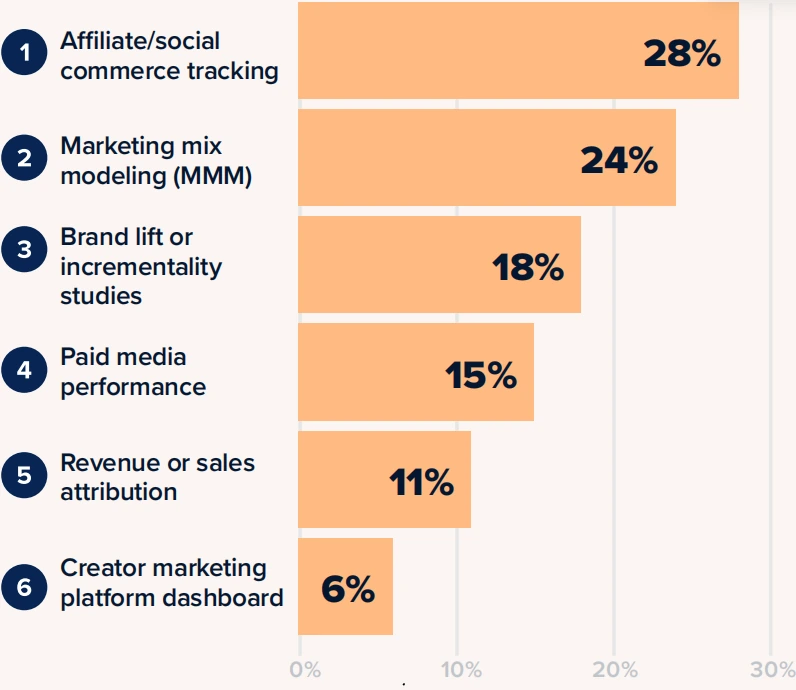
Brands consider revenue or sales attribution the most effective way to demonstrate business impact for creator marketing. However, agencies report affiliate or social commerce tracking is the top measure to demonstrate impact to their clients.
While revenue tops the list for brands, it is penultimate for agencies. Similarly, agencies rank creator marketing dashboards last while it’s a top three method for brands.
The AI Paradox
AI is fueling growth while adding complexity
AI adds another layer to the infrastructure gap. AI is boosting creator marketing’s growth.
Among brands whose investments increased over the past year, 4 out of 10 say AI-related efficiencies contributed to that additional investment. AI is fueling growth for creator marketing, but it’s also adding complexity.
41%
of brands reallocated funds from AI-related efficiencies
For organizations overall, 47% say AI has increased the day-to-day complexity of creator marketing, versus 37% who say it reduced complexity.
How AI affects complexity for marketers
How has AI affected the day-to-day complexity of your creator marketing program?
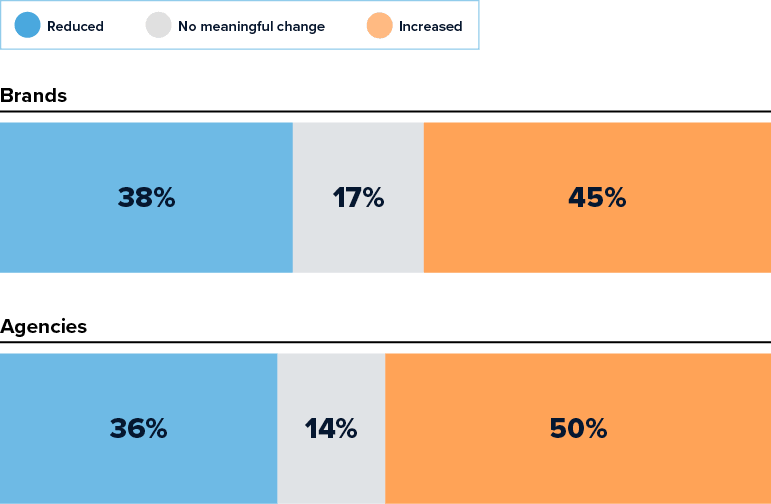
AI is complicating day-to-day functions more for agencies (50%) than brands (45%).
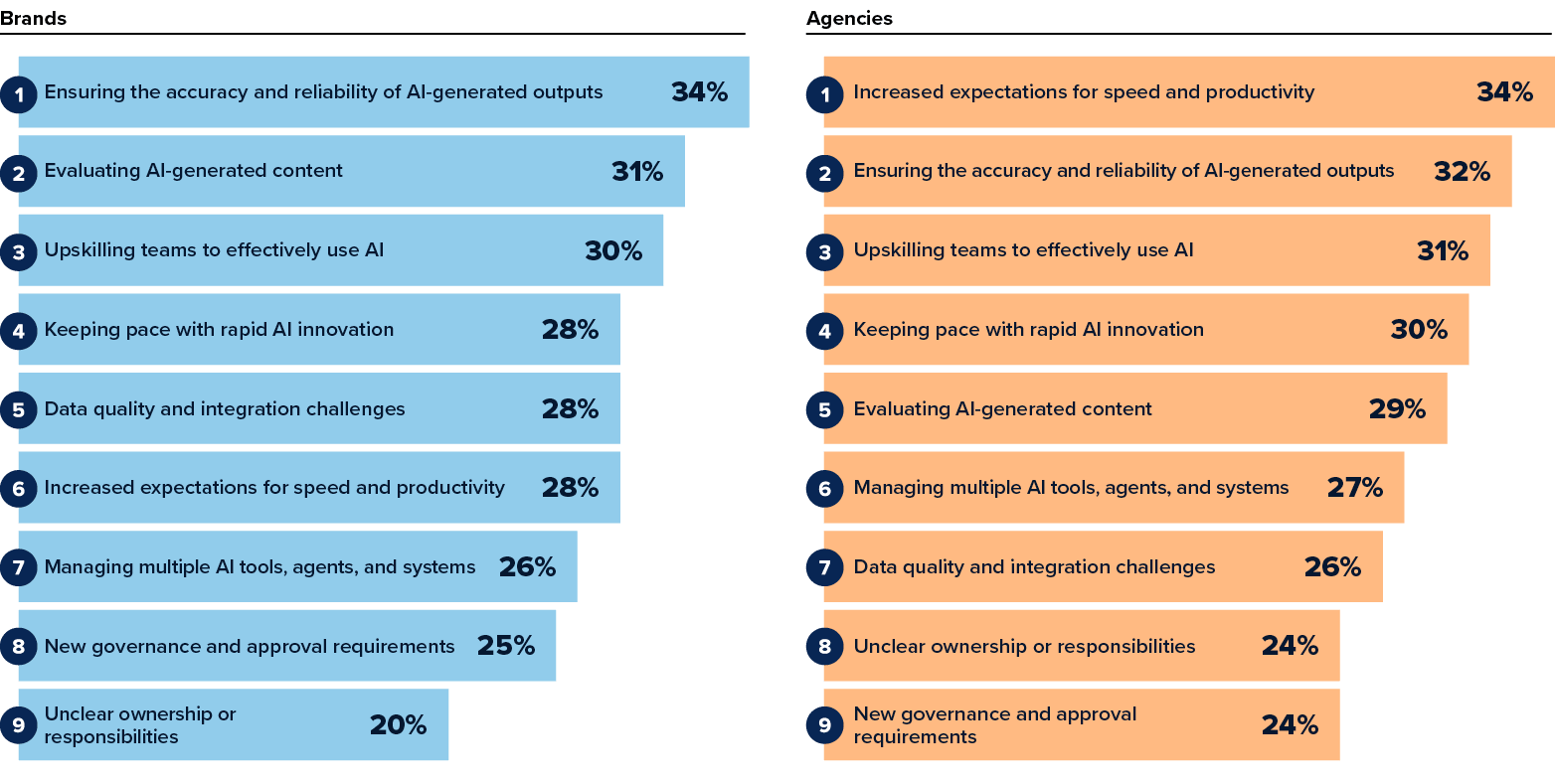
Complexity comes from the work required to put AI to use effectively. Some aspects are proving more challenging than others. For brands, ensuring the accuracy and reliability of AI-generated outputs is the leading source of increased complexity, followed by evaluating AI-generated content and upskilling teams. The top source of complexity for agencies is increased expectations for speed and productivity, mirroring what they say is the biggest change in client expectations from last year.
Why AI increases complexity
What has contributed most to that increased complexity?
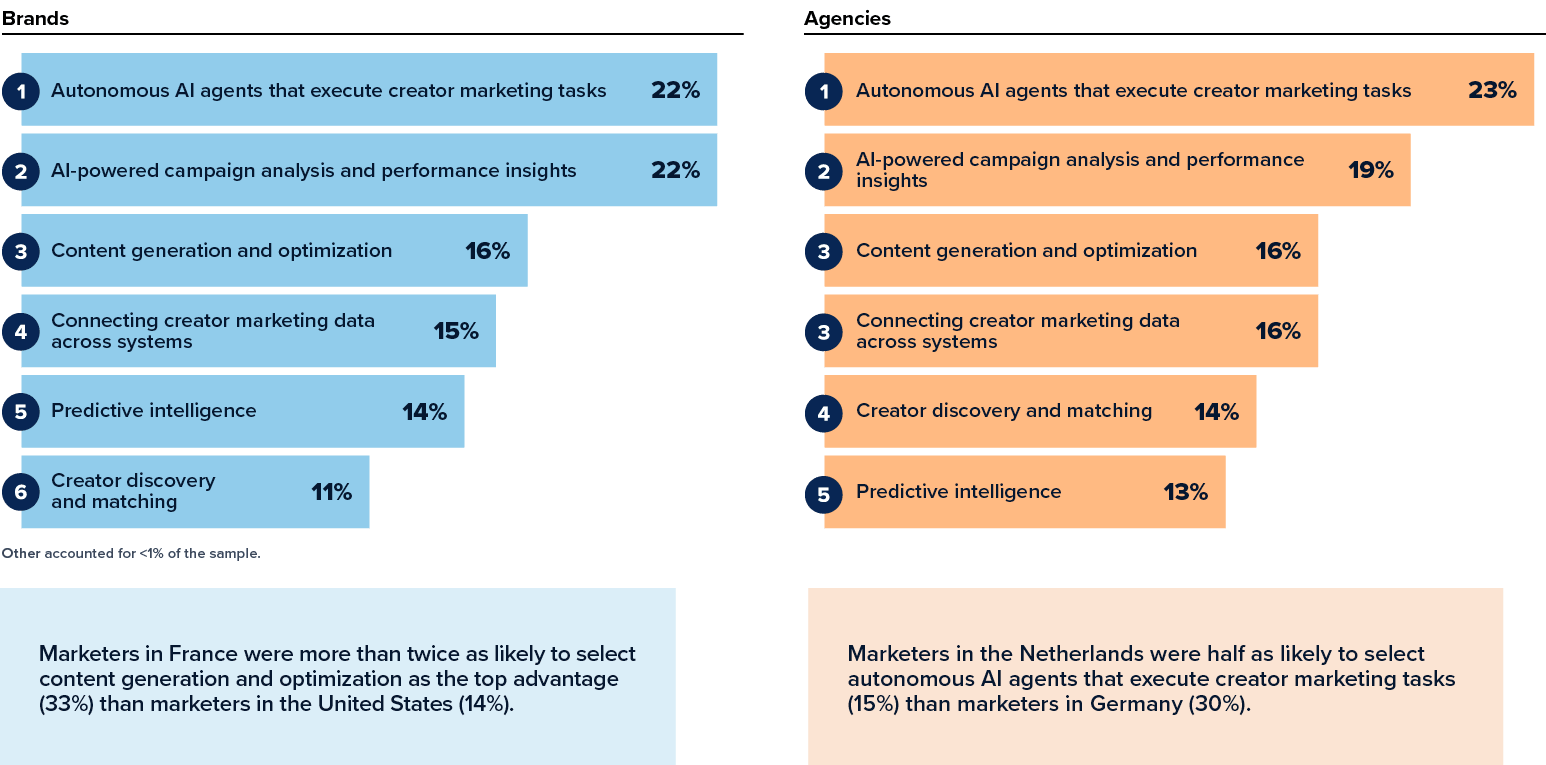
The added complexity isn’t dampening how marketers view AI’s potential. When asked which capabilities will create the greatest competitive advantage in creator marketing over the next three years, brands rank autonomous AI agents and AI-powered campaign and performance insights the highest, each at 22%.
AI capabilities that will create the greatest competitive advantage over the next three years
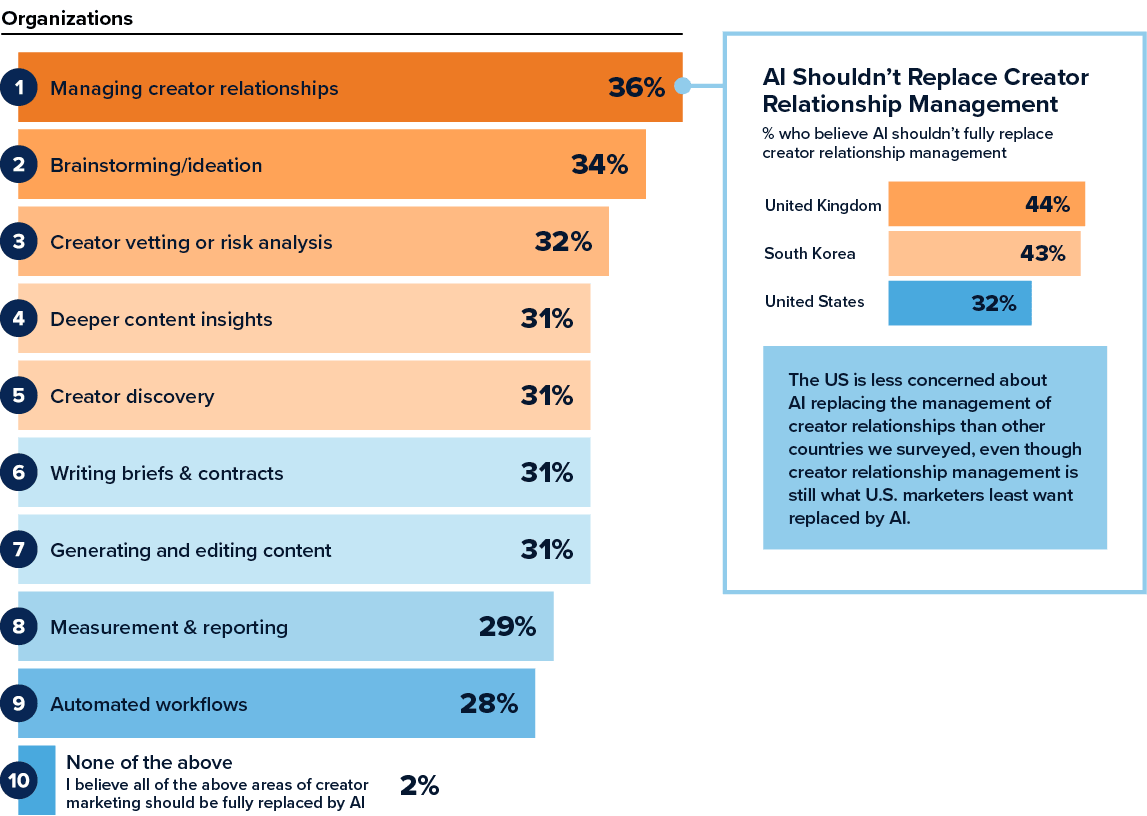
Marketers are drawing boundaries around AI’s role. Almost all believe some areas of creator marketing shouldn’t be fully replaced by AI, with managing creator relationships topping the list.
What marketers believe AI shouldn’t fully replace
Which of the following areas of creator marketing do you believe shouldn’t be fully replaced by AI?
While AI offers marketers transformation, it’s impacting creators differently. Creators are using AI largely as a creative utility. More than half primarily use AI tools for brainstorming, writing, or editing, while just 5% use it for strategy or workflow automation.
65%
of creators don’t feel pressure to use AI tools to stay competitive
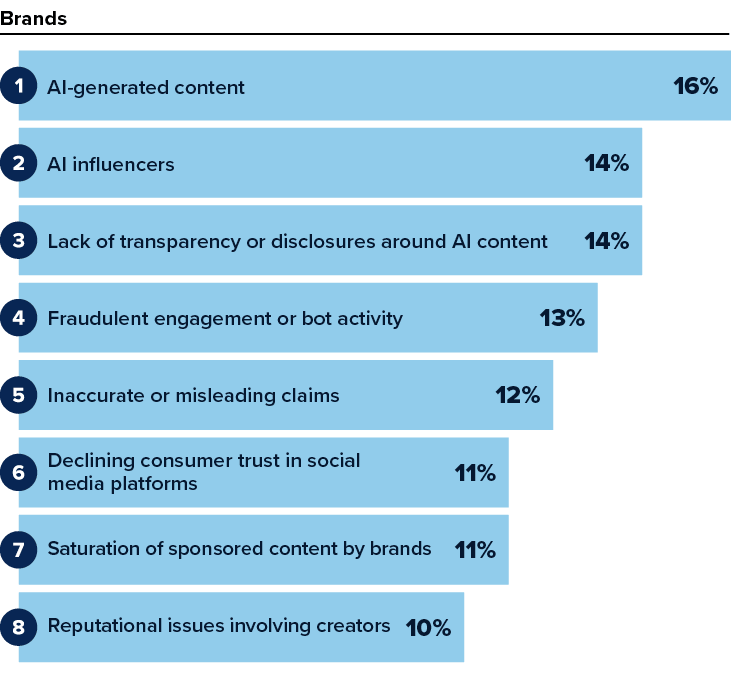
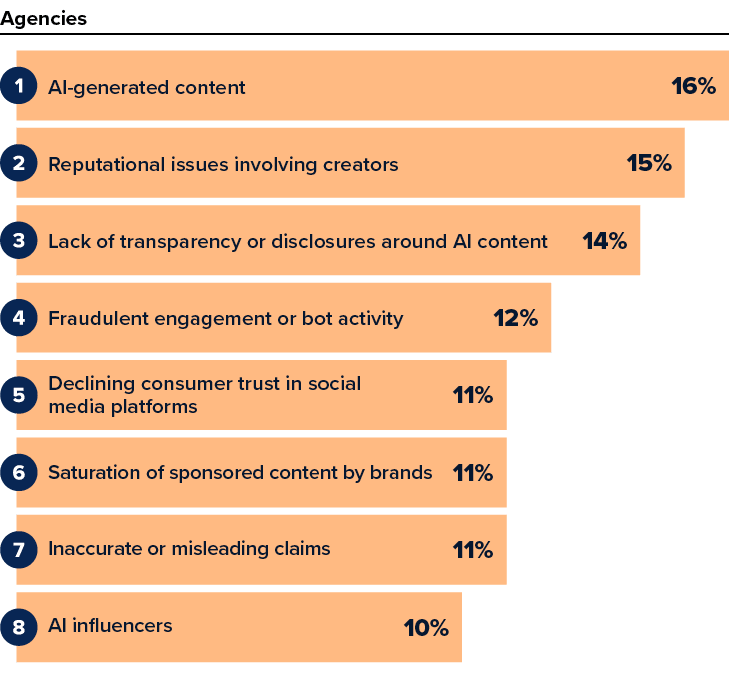
AI’s impact isn’t only operational. It’s also reshaping how marketers see trust. AI-related responses surfaced as the greatest threat to trust in the next three years, accounting for 44% of brand responses.
Threats to Trust in Creator Marketing
What poses the greatest threat to trust in creator marketing over the next 3 years?
AI is already creating value for marketers in many ways. However, they remain cautious about AI-generated content, which can produce more work for teams and remove human judgment from the process.
“AI is fueling growth, but it's also raising the stakes on consumer trust. The key is to ensure AI has guardrails and governance woven into the systems brands already run on. Trust at scale comes from control and configurability being engineered into workflows from the start, so brands can move fast without losing the confidence to stand behind every decision and creator relationship.”
What this means for marketers
Complexity isn’t inherently a problem. In fact, it’s a feature of some of the strongest creator marketing programs.
High-ROI Brands
High-return programs are built to manage complexity
Brands reporting 5x ROI aren’t operating simpler creator marketing programs. They have more people involved, commit more of their marketing investment to creators, and are more likely to say AI has increased complexity.
5x brands are also more likely to make streamlining creator operations a top priority. By comparison, 1x ROI brands prioritize building brand awareness and audience affinity through creators, as well as discovering new creators or strengthening existing partnerships.
63%
of 5x ROI brands say AI has increased the complexity of creator marketing
vs. 42% of 1x ROI brands
48
people are involved in creator marketing at the average 5x ROI brand
vs. 31 for the average 1x brand
28%
of 5x ROI brands rank streamlining creator operations across brands or regions as their top priority
vs. 1x brands who prioritize building brand awareness and audience affinity (25%) and discovering or strengthening creator partnerships (25%)
66%
of 5x ROI brands’ total marketing spend, on average, goes toward creator marketing
vs. 48% for brands overall
73%
of 5x ROI brands consider suitability, brand safety, and risk management very or extremely important to their creator marketing program
vs. 57% of 1x brands
5x brands
Brands reporting a 5x return on their creator marketing investment
1x brands
Brands who report breaking even with their creator marketing investment
Industry Leaders
Brands reporting 2x+ ROI and $1M+ in annual creator marketing spend
The same pattern appears among Industry Leaders, brands who report 2x or greater ROI and spend $1M or more on their programs. Even among these mature, scaled programs, 54% report greater complexity, compared with 37% of other brands. Complexity comes with maturity. Infrastructure determines whether that complexity becomes leverage or friction.
While AI adds to complexity for Industry Leaders, non-industry leader brands experience the reverse: AI reduces complications (44%) more than it introduces them (37%).
Creator Commerce
Nearly half of brands integrate creator commerce into their marketing strategy
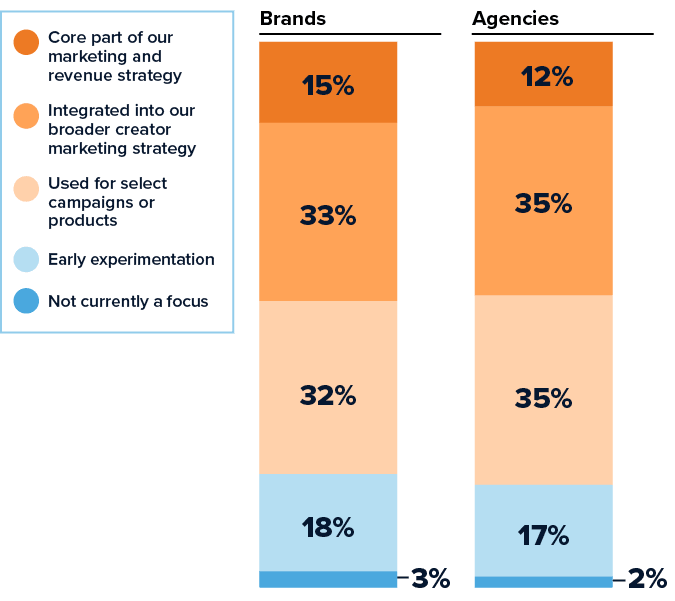
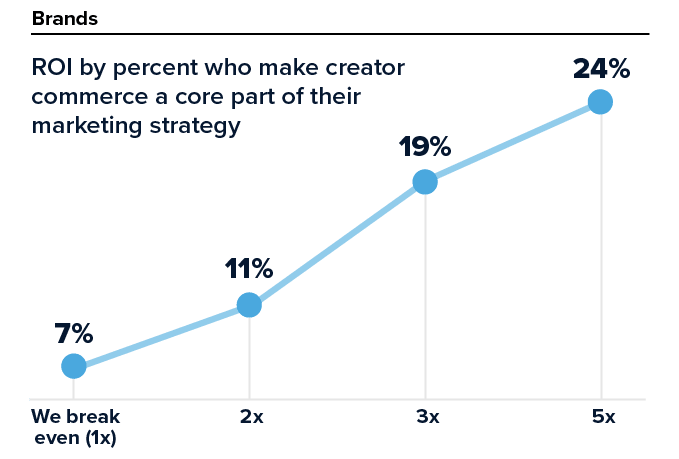
48% of brands have integrated creator-driven commerce into their marketing or revenue strategy. That number jumps to 80% when including marketers who use creator commerce for select products or campaigns. The role of creator commerce is even more pronounced among the brands reporting the highest returns.
The Majority of Brands Leverage Creator Commerce in Their Marketing
How would you describe your approach to creator-driven commerce today?
68%
of brands with creator-driven commerce as a core part of their marketing or revenue strategy have seen a 3x or greater return
85%
of agencies with creator-driven commerce as a core part of their marketing or revenue strategy have seen an increase in ROI over the past year
vs. 73% of agencies overall
Among brands who leverage creator commerce as a core part of their strategy, the most common industries are food & beverage (25%), retail (19%), and software, tech, & computing (18%). The least represented industries among industries with statistically significant representation are travel & hospitality (6%), financial services (8%), and automotive (8%).
Creator-Driven Commerce Grows More Central as ROI Rises
Top-ROI Drivers
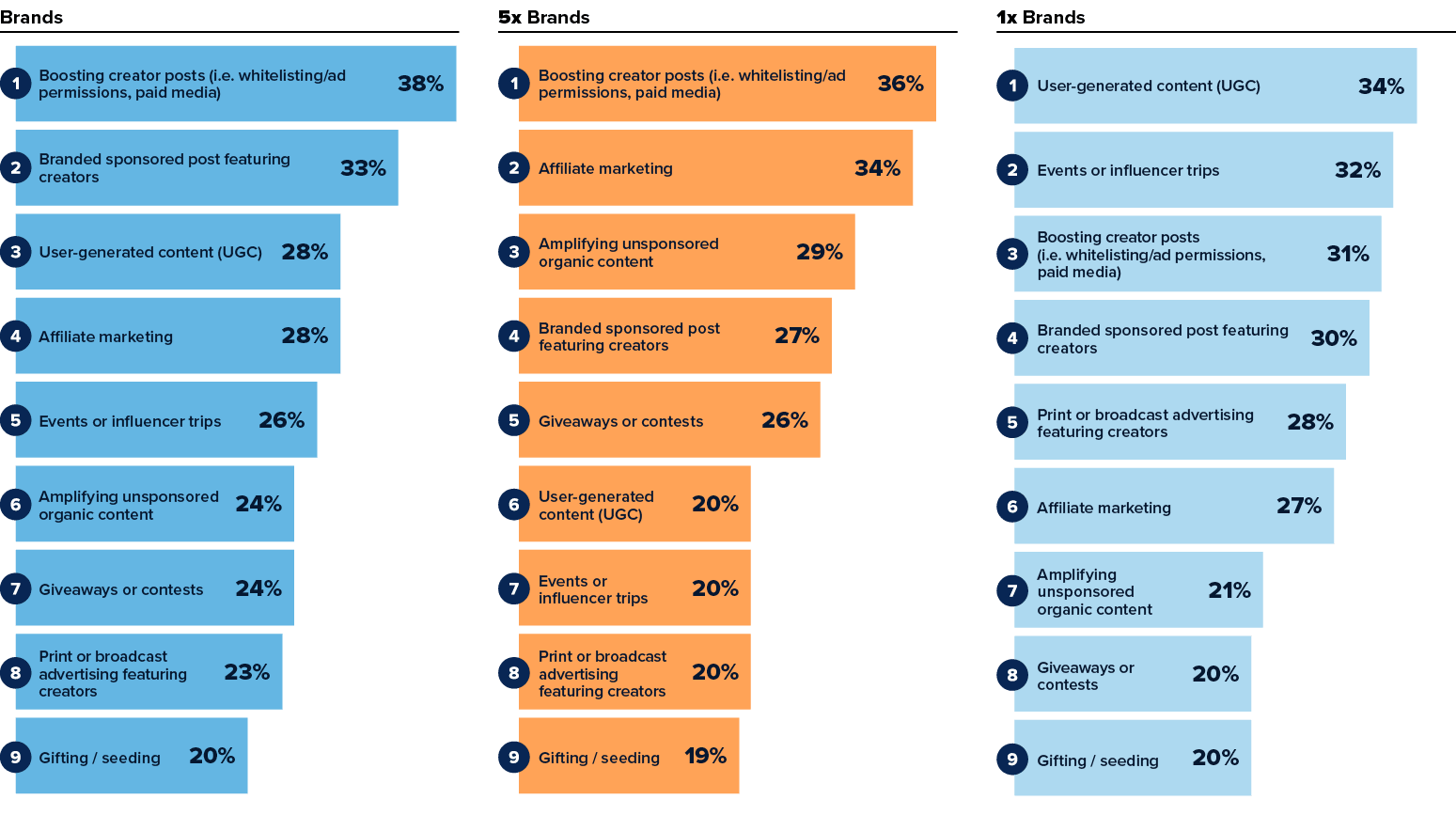
Which of the following influencer marketing activities have driven the most ROI for your organization over the past year?
What this means for marketers
Taken together, the findings suggest that the highest-return programs aren’t built around a single creator tactic. They put multiple parts of the creator ecosystem to work across brand, performance, and commerce.
Social Platforms
Social platforms remain the anchor of an expanding creator ecosystem
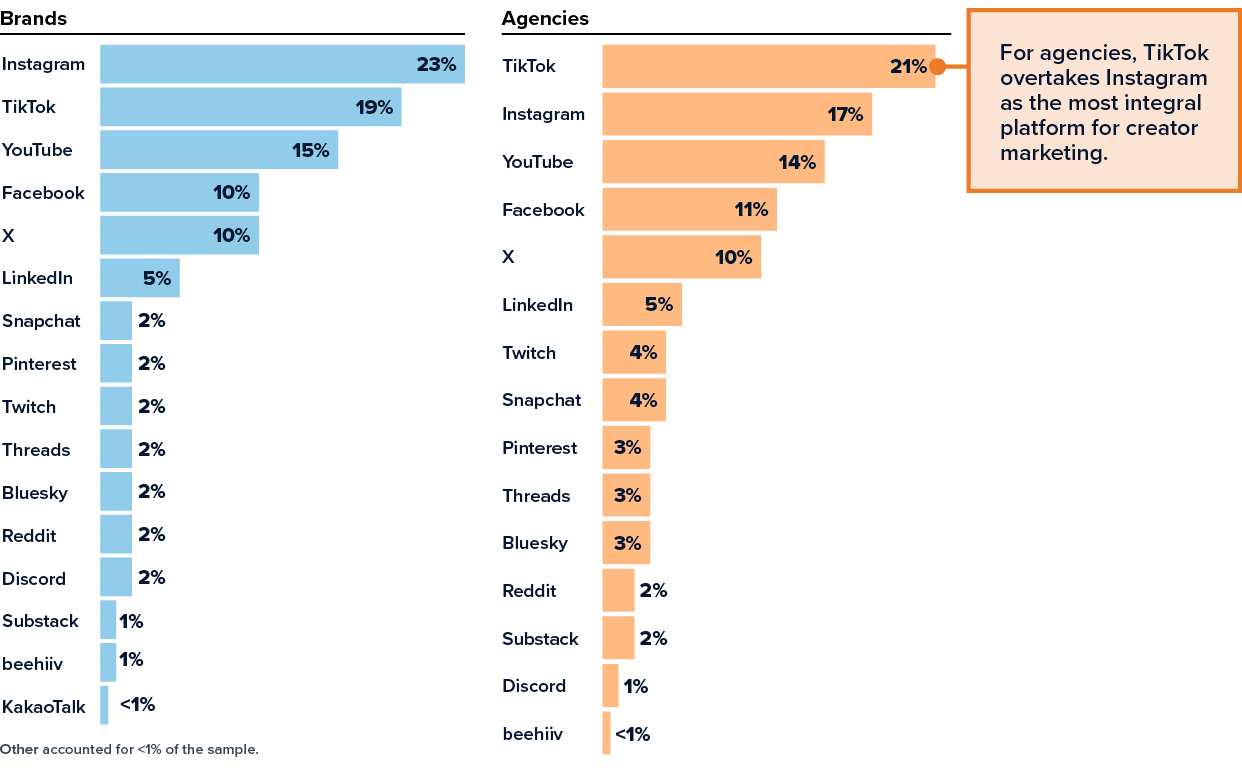
The social landscape is getting broader. This year, marketers reported using creator marketing across a range of 17 social platforms, reflecting an ecosystem that gives brands and agencies more options for where and how creator marketing shows up.
At the same time, major social platforms like Instagram, TikTok, YouTube, and Facebook remain central. CreatorIQ data reinforces their continued prominence: from August 2025 to July 2026, 99% of CreatorIQ customers used Instagram, 93% used TikTok, 80% used YouTube, and 79% used Facebook.
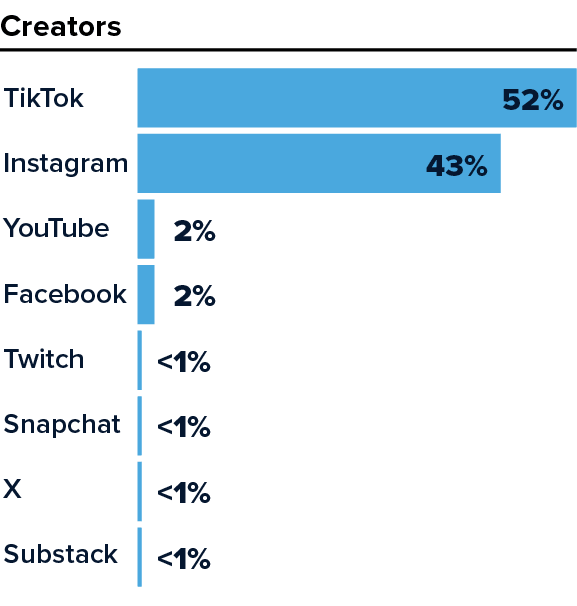
Widespread usage doesn't mean every platform plays the same strategic role. Asked which single platform is most integral to their creator marketing, brands, agencies, and creators reveal different centers of gravity. For brands, Instagram was first, followed by TikTok and YouTube. Agencies put TikTok first, followed by Instagram and YouTube.
The platform mix is only one piece of a broader shift. As marketers repurpose creator content, it moves beyond social into paid media, commerce, events, TV, and other areas of the business. Social platforms remain an anchor, even as the creator marketing ecosystem expands around them.
Most Integral Social Media Platforms for Creator Marketing
Which social media platform is most integral to your influencer marketing strategy?
Primary Platform for Branded Content
What this means for marketers
The right platform mix increasingly depends on audience, objectives, content, and business model.
Influence, Orchestrated
Influence, Orchestrated
Creator marketing has evolved from a channel into a system of influence that spans content, media, commerce, data, technology, and teams across the business.
The organizations best positioned to capture its value are making those parts work better together.
Orchestration is how complexity becomes an advantage.
Creator content can move across channels without creating disconnected workflows. Performance signals can flow back into creator strategy. Commerce data can inform partnerships and investment. AI can accelerate decisions without replacing the relationships and judgment that make creator marketing effective.
Doing this well requires infrastructure that connects decisions across the creator marketing ecosystem.

People
Align teams and stakeholders around shared priorities and accountability.

Process
Build workflows that move creator programs and content efficiently across teams, markets, and use cases.

Data
Connect creator, media, commerce, and brand signals into a coherent view of performance.

Technology
Connect workflows and intelligence, using AI to accelerate decisions while preserving human judgment where it matters.
Creator marketing has already proved that it can work at scale. The next advantage will come from turning scale into a system.
What this means for marketers
The future of creator marketing is influence, orchestrated.
Next steps
Recommendations
One action per chapter, drawn directly from this year’s findings.
 Make the case for investment on returns, not risk — 48% of brands already report 3x+ ROI, and budgets are growing on the strength of that performance.
- Treat integration as the next infrastructure priority. Connecting data and workflows across systems is now a bigger blocker than budget or headcount.
- Pick a primary measurement approach for each goal instead of searching for one model that explains everything — no single method commands even one-in-five votes.
- Deploy AI where it reduces friction — research, editing, reporting — and keep humans in every relationship, brief, and vetting decision.
- Study how 5x ROI brands operate: more people, more budget share, and more focus on streamlining operations, not just building awareness.
- Treat commerce and platform mix as strategic choices, not defaults — both compound with ROI when made core to the strategy.
How this report was built
About this survey
This research was completed by Sapio Research and CreatorIQ in 2026. Sapio Research conducted interviews online using an email invitation and an online survey in July–August 2026. CreatorIQ performed additional research in August 2026, pulling data from CreatorIQ surveys dating back to 2020.
The research from Sapio Research’s study polls 2,000 decision makers within marketing teams in brands and agencies across the USA, UK, France, Netherlands, Germany, South Korea, Italy, Saudi Arabia, and UAE. In this particular study, the chances are 95 in 100 that a survey result does not vary, plus or minus, by more than 3.0–3.2 percentage points from the result that would be obtained if interviews had been conducted with all persons in the universe represented by the sample.
Demographics
Size
| Size | Brands | Agencies |
|---|---|---|
| 1–15 employees | 8% | 4% |
| 15-100 employees | 15% | 11% |
| 101-250 employees | 24% | 26% |
| 251-1,000 employees | 29% | 35% |
| 1,001-10,000 employees | 18% | 19% |
| More than 10,000 employees | 5% | 4% |
Industry
| Industry | Brands | Agencies |
|---|---|---|
| Software, Technology, & Computing | 18% | 27% |
| Retail | 16% | 17% |
| Fashion & Apparel | 8% | 7% |
| Financial Services | 8% | 10% |
| Media & Entertainment | 7% | 7% |
| Business | 6% | 10% |
| Automotive | 5% | 2% |
| Beauty | 5% | 3% |
| Consumer Electronics | 4% | 2% |
| Health & Wellness | 4% | 2% |
| Food & Beverage | 4% | 2% |
| Travel & Hospitality | 3% | 1% |
| Telecommunications | 3% | 2% |
| Home & Garden | 2% | 2% |
| Education | 2% | 2% |
| Sports | 1% | 1% |
| Gaming | 1% | 1% |
| Other | 3% | 3% |
Countries
| Countries | Brands | Agencies |
|---|---|---|
| United States | 54% | 60% |
| United Kingdom | 23% | 16% |
| Korea | 6% | 6% |
| France | 3% | 3% |
| Italy | 4% | 4% |
| Germany | 4% | 4% |
| Netherlands | 4% | 4% |
| Saudi Arabia | 1% | 1% |
| United Arab Emirates | 1% | 1% |
More research from CreatorIQ
What to read next
Dive into the marketing reports that unpack what it really takes to build lasting creator programs—the operational foundations behind high-performing work, not the highlight reel.

Ready to orchestrate what’s next?
Turn creator data into decisions that win with CreatorIQ.