

.png)
POSSIBLE Miami lived up to its name. As a first-timer, I came in curious—and left with pages of notes and a lot to think about. The through-line across sessions? What it actually takes to do creator marketing well.
One thing came through loud and clear: the creator economy isn't a channel to experiment with anymore. It's the infrastructure modern marketing runs on.
Here's what I took away and what I think it means for how brands need to operate going forward.
1. All marketing is performance marketing (so measure like it)
The divide between brand and performance marketing is collapsing (and honestly, it should be). The most forward-thinking brands at POSSIBLE are moving toward a single growth metric, one that ties marketing directly to business outcomes like new consumer acquisition.
Coca-Cola's Global CMO Manuel "Manolo" Arroyo made this click for me: his team has moved away from siloed brand and paid marketing measurement entirely. Their north star is a single weekly consumption metric. The board conversation, he said, comes down to two questions: "Is marketing driving the business?" and "How is our brand being represented?" Everything else is noise.
Honestly, I didn't expect the most direct answer on measurement to come from one of the biggest brands in the world—but here we are!
The takeaway: Define your north star metric before you build your creator strategy (not after).
2. Everyone's doing creator marketing. Not everyone's doing it right.
This came up in almost every session I attended, and it's worth saying plainly: most brands are still chasing trending creators instead of the right creators.
Viral reach looks good in a deck. It doesn't build brand equity. The brands seeing real results are the ones finding creators with genuine shared values, letting them lead creatively, and investing in long-term relationships rather than one-off activations.
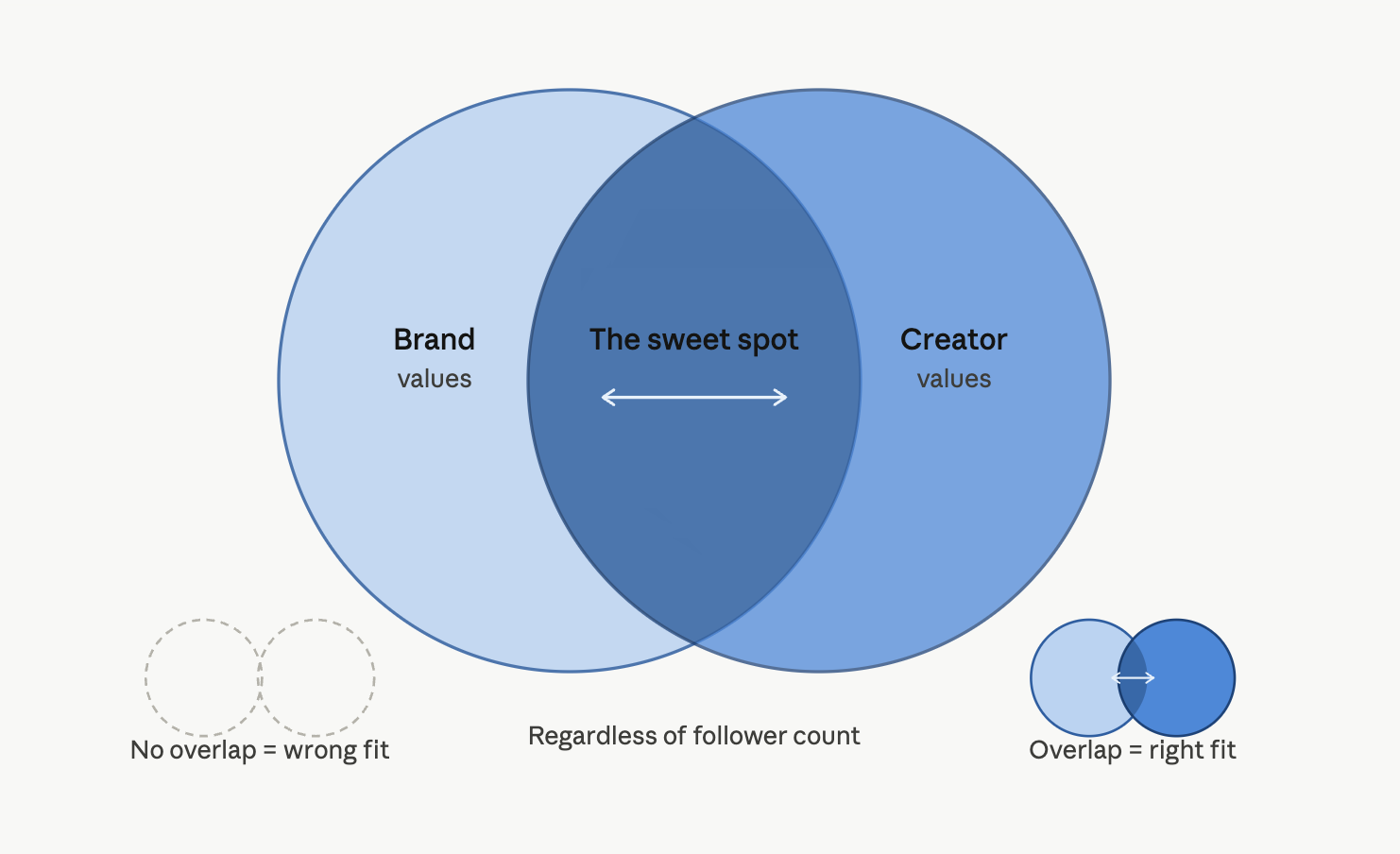
A simple gut-check I heard: build a Venn diagram of your brand's values and the creator's values. If there's nothing in the middle, it's not the right partnership—no matter how big their following is.
Creators aren't content vendors. They're trusted voices with communities that took years to build. When brands treat them like creative partners rather than promotional vehicles, the work lands differently.
The takeaway: Fewer, better partnerships will always outperform a long list of one-offs. Episodic storytelling, always-on collabs, creator-led formats that live beyond the platform—that's where the results are.
3. Audience size is the wrong thing to optimize for
Audiences consume. Communities advocate. That distinction kept coming up at POSSIBLE, and it's one of the most important strategic reframes in creator marketing right now.
Creators with true communities (not just follower counts) are significantly more likely to drive conversion. Micro and nano creators especially punch above their weight because their audiences follow them for something specific. That specificity equals trust, and trust converts.
PepsiCo's Global Head of Creative & Content Transformation Kate Brady put it plainly: consumers trust a creator's POV on a brand more than they trust what the brand says about itself. Her team has found that micro and nano creators consistently drive stronger engagement than macro creators—and that building a sustained network of them is more valuable long-term than any single big-name bet.
Sacheu Beauty co-founder Sarah Cheung echoed this from the creator side: smaller, niche creators earn trust because they stand for something specific and show up consistently.
That one landed differently than I expected—because it means no matter how strong your brand voice is, it's already starting at a disadvantage when it speaks for itself.
The takeaway: Audit your creator mix. If you're over-indexed on reach and under-indexed on relevance, you're leaving conversion on the table. A sustained network of micro and nano creators, done right, can outperform a single macro bet.
4. The brief is broken
This was some of the most direct feedback at POSSIBLE—and it came from creators themselves. The traditional brief, with its layers of reviews and approvals, is getting in the way of good work.
I expected creators to be diplomatic about this (spoiler: they weren't!).
Creator and founder Dhar Mann was blunt: the ad brief kills trust. Too many approval layers strip out the authenticity that makes creator content work. His best brand partnerships are built on direct conversations and genuine creative collaboration—not compliance exercises.
Creator and sports commentator Katie Feeney added what actually signals a great partnership: a brand that has taken the time to review her content, reference specific things she's already done, and notice what she's already building.
PepsiCo's Kate Brady offered the right operating principle: be tight on outcomes, brand guidelines, and legal—and loose on creative process. Creators own their audience and their voice. That's what you're partnering with.
The takeaway: Shorten the approval chain. Protect the creator's voice; it's literally what their audience showed up for.
5. AI is a capability, not a talking point
AI was everywhere at POSSIBLE, but the most useful conversations weren't about AI as a trend. They were about AI as an operational shift.
A few things that stuck with me: brand deal timelines are compressing fast—what used to take 4–6 weeks is now expected in a week. AI is valuable for internal planning, insights, and workflow, but it's not a substitute for originality in front of an audience. And calling something "AI-powered" in your marketing is the new "digital"—it signals nothing. Audiences don't trust the buzzword; they trust the people behind it.
The best creators are moving from instrument player to conductor—using AI to move faster and stay in the cultural conversation in real time, without letting it replace their point of view.
The takeaway: Invest in AI literacy, not just AI tools. And if your brand is leaning on AI as a headline, stop.
6. Full-funnel is still the biggest gap
The most common failure mode I heard at POSSIBLE: a brand pays for creator content, gets the awareness hit, and stops there. No comment engagement. No repurposing. No connection to conversion further down the funnel. That's wasted investment—and it's more common than it should be.
Unilever US's Chief Brand Communications Officer Casey De Palma framed the upside: when you build a community that genuinely works for both parties, they're ready to advocate when you need to activate. That doesn't come from one campaign. It comes from ongoing investment—and from actually showing up in the conversations your creators are having with their audiences.
The smarter move: track qualitative signals (comments, shares, cultural conversation) alongside conversion data, and know which part of the funnel you're trying to impact before you pick a creator or a format.
The takeaway: Map every creator activation to a funnel stage. Repurpose the content. Engage in the comments. Define success before you launch.
7. Longer formats are winning—and so is experiential
I walked in expecting the answer to the "war for attention" to be "go shorter." It wasn't.
Short-form content isn't going anywhere. But something shifted in the conversation at POSSIBLE: longer formats are winning on depth, trust, and staying power.
Audiences are spending real time with episodic series, long-form storytelling, and experiential moments that creators bring to life across platforms. Events and festivals amplified by creator presence are creating the kind of cultural moments that a 15-second clip can't replicate.
Creators hosting podcasts, doing street interviews, appearing at live events–that's content that builds the brand association TV advertising used to own.
The takeaway: Think beyond content formats. Think about moments, context, and where your audience actually chooses to pay attention.
What I took home
My first POSSIBLE made one thing clear: the "should we invest in creators?" question is settled. The real question now is how sophisticated your creator strategy actually is.
The brands pulling ahead are treating creator marketing like a core business function—with real measurement, long-term partnership thinking, and genuine creative collaboration. The ones falling behind are the ones still treating it like a line item.
The playbook is still being written. But the brands that win will be writing it alongside their creators—not for them.